Specifying the wrong equipment for a hazardous area is one of the most common — and most expensive — mistakes in industrial procurement. Before you can choose an ATEX or IECEx certified generator, compressor, control panel or forklift, you need to know exactly which zone it will operate in. Get the zone wrong, and even a fully certified piece of equipment can be the wrong piece of equipment.
This guide walks through what Zone 1 and Zone 2 actually mean, how they differ, and how that classification drives every other decision — enclosure rating, gas group, temperature class — when specifying explosion-proof equipment.
What Is Hazardous Area Classification?
A hazardous area is any location where an explosive atmosphere — a mixture of flammable gas, vapour, mist or dust with air — may be present in quantities that require special precautions for the construction, installation and use of equipment. Oil & gas facilities, offshore platforms, petrochemical plants, chemical storage warehouses and gas separation units are all typical hazardous-area environments.
Under the ATEX Directive (2014/34/EU) and the IECEx international certification scheme, hazardous areas are divided into zones based on how likely and how often an explosive atmosphere is present.
Zone 1 vs Zone 2: The Key Difference
| Zone | Definition | Typical Locations |
|---|---|---|
| Zone 0 | Explosive atmosphere present continuously or for long periods | Inside storage tanks, closed process vessels |
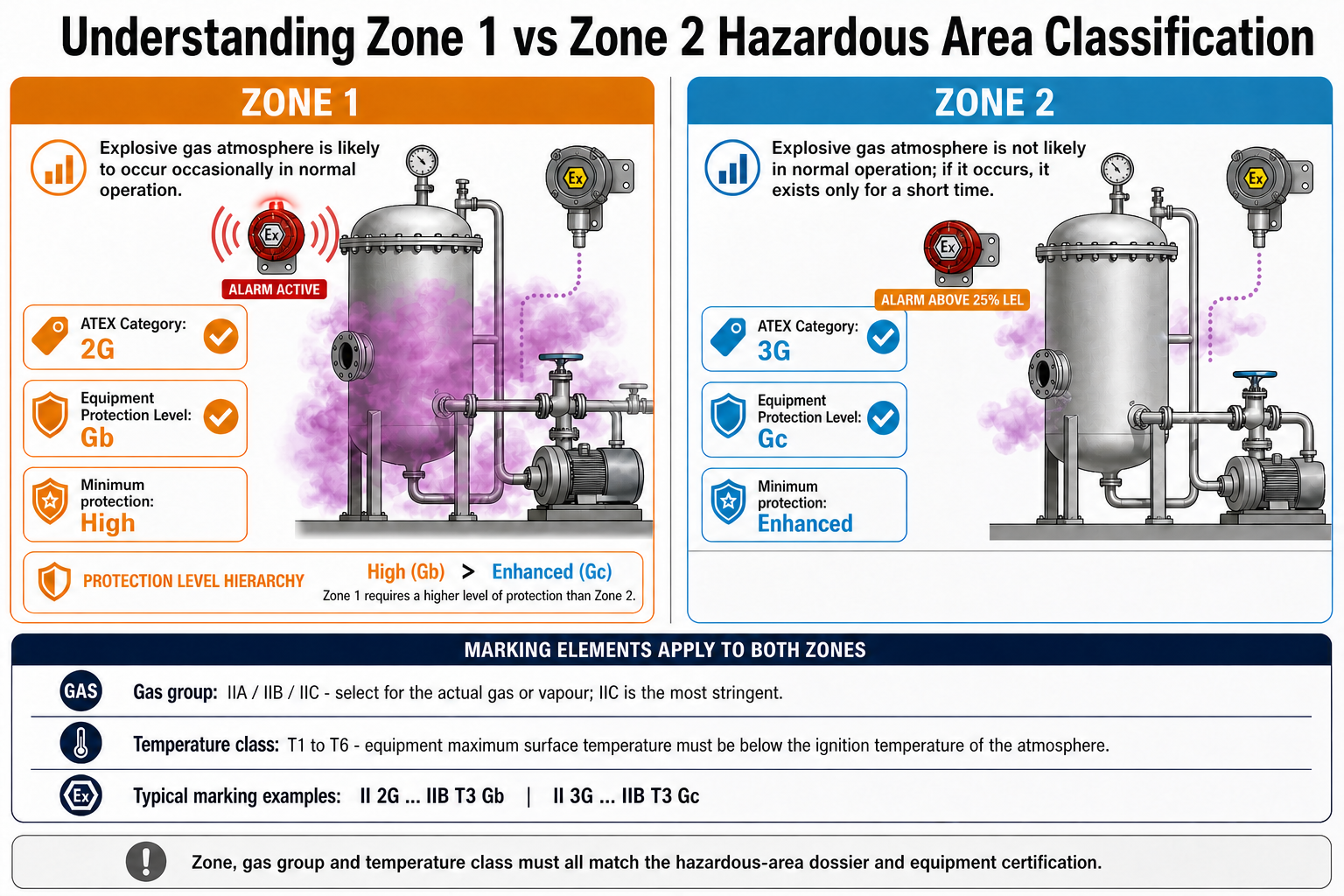
| Zone 1 | Explosive atmosphere likely to occur periodically during normal operation | Areas near loading points, pump seals, sample points |
| Zone 2 | Explosive atmosphere not likely to occur in normal operation, and if it does, only briefly | Areas around Zone 0/1 boundaries, well-ventilated outdoor plant areas |
In practical terms: Zone 1 equipment must be built to a higher standard of protection because ignition-capable atmospheres are expected as part of normal, everyday operation. Zone 2 equipment is designed for areas where that risk is abnormal or transient — a leak, a malfunction, a maintenance error — rather than routine.
Why This Matters for Equipment Selection
Every explosion-proof generator, compressor, control panel or forklift SunEx supplies is certified to a specific zone, gas group and temperature class combination. Choosing equipment rated for the wrong zone isn’t just a compliance gap — it’s a genuine safety risk and will typically fail an HSE audit or insurance inspection outright.
- Equipment protection level (EPL) — Zone 1 equipment is generally marked Ga/Gb (gas) or Da/Db (dust); Zone 2 equipment is marked Gc or Dc.
- Type of protection — flameproof (Ex d), increased safety (Ex e), intrinsic safety (Ex ia/ib) and pressurisation (Ex p) are all common approaches, each suited to different equipment types and zones.
- Gas group — IIA, IIB or IIC, reflecting the specific flammable substances present and how easily they ignite.
- Temperature class — T1 to T6, capping the maximum surface temperature the equipment is allowed to reach.
ATEX and IECEx — What’s the Difference?
ATEX is the European Union’s regulatory directive (2014/34/EU) covering equipment intended for use in explosive atmospheres within the EU. IECEx is the international certification scheme, recognised across Southeast Asia, the Middle East and beyond, that verifies equipment against the same underlying IEC standards. Most projects across Singapore, Malaysia, Thailand, Vietnam, Indonesia and the Gulf region will call for IECEx certification, ATEX certification, or both — SunEx equipment is certified to both wherever applicable, with full documentation supplied on delivery.
Getting Zone Classification Right, From the Start
Zone classification is normally determined by a qualified process safety engineer as part of the facility’s hazardous area classification study, well before equipment procurement begins. If that documentation already exists for your site, our engineering team can match it directly against our product range. If it doesn’t, we can guide you through the questions that typically determine the right zone, gas group and temperature class for your application.
Every SunEx product — from Zone 2 diesel and gas engine generators to Ex control panels, explosion-proof air compressors and Zone 1/Zone 2 forklifts — is supplied with full ATEX and IECEx documentation, including the Manufacturer’s Declaration of Conformity, so your procurement and HSE teams have everything needed for sign-off.